It’s been over a year and a half since I last posted here at Cultural Learnings, and so I doubt anyone is following this so closely and yet not aware of what’s happening via my social media channels. But just in case you land here looking for my review of House of the Dragon or anything else, I’ve moved all my criticism to a Substack newsletter, Episodic Medium, where I’ve been joined by fellow A.V. Club alum like Donna Bowman, Zack Handlen, and Noel Murray.
When The Happiest Season debuted on Hulu in November, having been shuffled to the streaming service after the COVID-19 pandemic closed cinemas around the world, the significance of its release was somewhat muted. It was originally touted as the first major studio lesbian romantic comedy, following in the footsteps of 2017’s Love, Simon in breaking new ground for queer representation within genres exclusively imagined as heterosexual in a theatrical context. And while that fact essentially remains true, the set at Christmas film’s move to Hulu obscured that distinction, meaning The Happiest Season launched at a time when Netflix and an increasingly large number of cable channels are releasing a slew of holiday rom-coms. This places the movie it into a different conversation about how the snowy cottage industry of “Cable Christmas Movies” is navigating similar questions of inclusion, with three channels (Hallmark, Lifetime, and Paramount Network) also using queerness as a point of articulation this holiday season.
Directed by Clea DuVall, The Happiest Season has structural advantages compared to your average Hallmark or Lifetime Christmas movie: it has a veritable movie star in Kristen Stewart, supporting players like Aubrey Plaza and Alison Brie, and the budget to hire a stacked supporting cast and ensure it doesn’t aesthetically look like it was produced at the rapid pace of a daytime soap opera. It’s not really a fair fight in terms of filmmaking or the depth of the ensemble, but The Happiest Season was nonetheless faced with the same narrative question as the year’s other attempts to “Queer the Christmas Movie” on cable: how do you reconcile the continued struggle LGBTQ individuals face in finding love (and living life) with the genre’s sweeping, romantic happy endings?
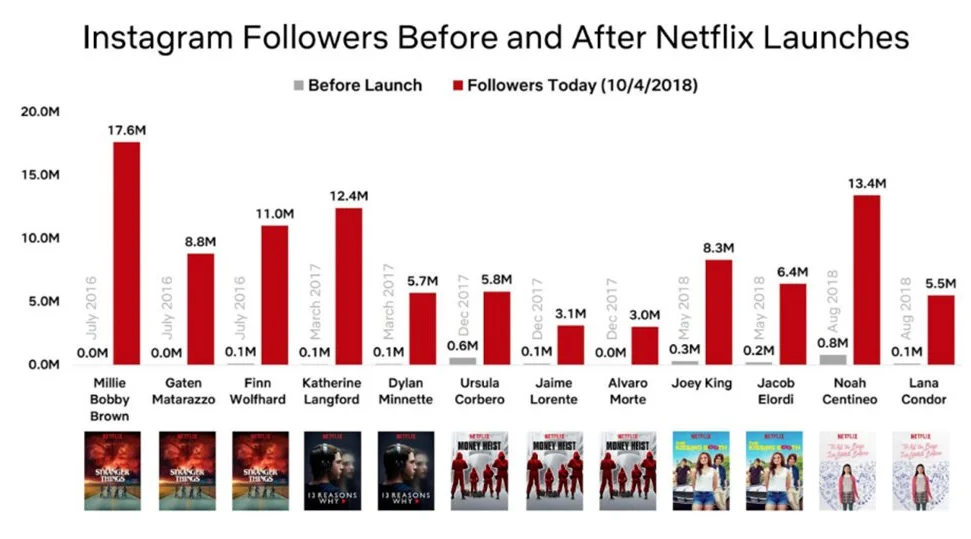
In the fall of 2018, Netflix was still not releasing formal ratings data for its original programming, but they were nonetheless invested in using data to demonstrate their cultural influence. And in October of that year, they produced a chart to demonstrate their programming’s capacity to grow the online followings of their young stars across both series and films aimed at young adult viewers. This included the stars of Stranger Things, 13 Reasons Why, The Kissing Booth, and To All The Boys I’ve Loved Before, in addition to an international lift for the stars of the Spanish Netflix original Money Heist.
Source: Netflix
There is something very mundane about the basic message of this chart, which is that actors who star in successful television shows watched by millions of people will grow their followings on social media platforms. But from Netflix’s perspective, it demonstrates the influential role that Netflix in particular plays in the lives of its viewers, as they didn’t simply watch these shows, but took the extra step of following the actors involved, further integrating these story worlds into their social media feeds. And the exponential growth for stars like Millie Bobby Brown and Noah Centineo—To All The Boys… had debuted only six weeks before this chart was created—was a way to showcase how quickly a Netflix project can capture the zeitgeist, and rocket the young stars involved to stardom.
But, as I asked at the time, what’s next? How does Netflix feel they are able to benefit from the “social lift” provided to the young actors of these and other—On My Block, Outer Banks—shows and movies aimed at similar audiences? While those social followings are valuable for driving interest in additional seasons or sequels to the projects in question, Netflix has been slow to capitalize on the potential to expand their investment in these performers across their prolific production slate. While there is some crossover between Money Heist and Elite, and Brown (Enola Holmes) and Katherine Langford (Cursed) returned to the Netflix family in new roles this year, Noah Centineo remains the only actor who I would argue has—for better or for worse—been positioned as a “Netflix Star,” in the vein of the Disney Channel star system that’s a logical reference point for teen-focused projects.
This vein has been particularly relevant this month after Netflix debuted Julie and the Phantoms, a musical dramedy helmed by Kenny Ortega, who directed the High School Musical and Descendents films for the Disney Channel. The show stars newcomers Madison Reyes and Charlie Gillespie as a teen struggling to find her voice after her mother’s death and the lead singer of a band who died tragically 25 years earlier as a teen, returned as a ghost with his bandmates with some unfinished business. They’re star-making roles, and very much the kind of roles that would have made them Disney Channel stars in that context, and the “Netflix Instagram Effect” confirms: in only two weeks, starting more or less from scratch, Reyes passed 285,000 followers, while Gillespie crossed over 450,000 over the same period.
But whereas it’s easy to picture how the Disney Channel would take talented young actors and leverage them across their brands, it’s less clear what precisely Netflix can do to make use of the multi-hyphenate stars of their latest youth series that isn’t just renewing the show and generating some content given the state of the “Netflix Star” in the two years since the chart referenced above. Whether out of disinterest, disorganization, or disagreement, Netflix has mostly allowed its star-making capacity to begin and end with the shows and films that made them stars, despite having clear avenues to use those followings to their advantage.
When my journal article about Taylor Swift’s articulation of authorship during her transition from country to pop was held up in editorial for a lengthy period (a not uncommon occurrence in academic publishing), I thought it meant it was too late: in the time I was revising the article, Swift started an entire new album cycle with Lover, and when the article finally came out in March of this year she had just released her documentary Miss Americana on Netflix. I wrote a blog post reflecting on how my argument connected with those new developments, thinking that this would be the only necessary addendum until 2021, when Swift would (given past precedent) begin her next album cycle.
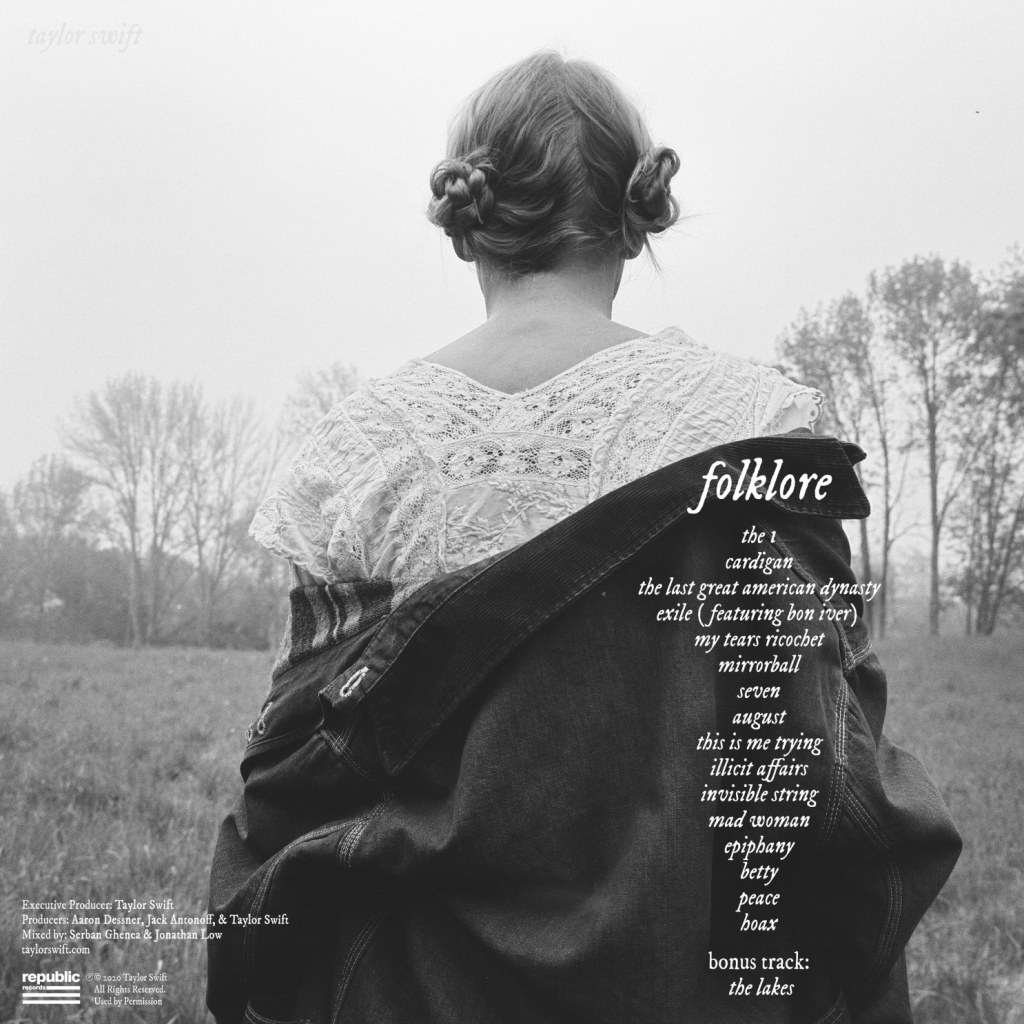
Needless to say, this all changed on Thursday, when Swift gave fans 16 hours to process the news that her next album cycle was starting at midnight with the release of folklore, her eighth studio album, recorded remotely during the COVID-19 pandemic. While a music video for “Cardigan” effectively frames it as the “lead single,” there is none of what we expect from a traditional album release in 2020: no trickle of advance singles, no lyric video/music video staggering to game the charts, etc. But what buildup we got from Taylor was nonetheless instructive, designed to frame this record and a new songwriting collaboration—with The National’s Aaron Dessner—both within her previous music and as a new form of creative process reflecting our current circumstances. It’s the next chapter in what I wrote about, and needless to say I dropped everything to immerse myself in both the album and, more importantly, what it says about the idea of Taylor Swift as an artist.
There’s no doubt that Folklore will go down as a definitive media artifact of this pandemic, the first “major work” to be entirely produced and released in social isolation, but its relationship to Swift’s authorship is less clear. Although one could argue it is easily one of her most cohesive and uncompromising albums, Folklore is nonetheless defined by contradictions: intimate but impersonal, isolated but collaborative. The result is a record that, despite making no grabs at tabloid headlines or Billboard dominance, says a whole lot about how Taylor Swift considers her place within the music industry, and how it’s built around embracing those contradictions in order to retain the hard-fought appearance of controlling her own destiny.
This article analyzes paratextual strategies deployed by Taylor Swift in her transition from country to pop in the context of her articulation of her authorship as a female songwriter. This was a transition complicated by the gendered hierarchies of pop music, wherein male producers carry significant discursive weight. The article frames the “Voice Memos” included with her 2014 album 1989 as a form of paratextual feminism, reiterating the authenticity she developed as a country star and pushing back against claims her collaboration with male producers like Max Martin and Ryan Tedder threaten her autonomy as a female voice in the music industry. However, the article goes on to consider how these and other paratextual feminisms are inherently tied to neoliberal values of post-feminism, demonstrating that their potential as a gendered critique of the media industries is limited by the lack of actualization within Swift’s broader star text and industry practice.
The article—which is trapped behind the paywall of academic publishing, but if you’re interested reach out and I’ll do my best to get you access—was nearly six years in the making. It began with my observations during her 1989 album cycle in 2014, which I developed into a 2016 conference paper focused on the “Voice Memos” included with the deluxe version of that album. But the subsequent years—her controversial silence during and after the 2016 election, a tumultuous reputation album cycle—provided new context for that analysis, testing how the feminism of her efforts to assert her authorship of her own songs while collaborating with male producers during her transition to pop music failed to manifest within other areas of her career.
As the paper entered into the final stages of peer review last summer, Swift entered into her latest album cycle for Lover, and I spent a lot of time lamenting that I was past the point where I could address everything that was happening (a peril of scholarly publishing). I was never afraid that my argument wouldn’t be relevant, as all scholarship must ultimately “stop” at a certain point and create a foundation for further analysis. But a lot has happened in Swift’s career in the six months or so after the article finished the peer review process, and I want to take a bit of space here to identify a few instances where the article’s argument connects with the discourse surrounding Swift’s recent activity.
For much of the back half of its run, Game Of Thrones has derived its tension from the Night King, and the question of whether the seven Kingdoms of Westeros could come together in order to stop this monumental threat. And so when the first half of the show’s final season ended with the Night King and his army completely erased, it raised the question of where the tension would come from for the rest of the story.
An Assemblage of Words in Response to is a new, probably ongoing project in which I give myself a limited time period to write words about things.
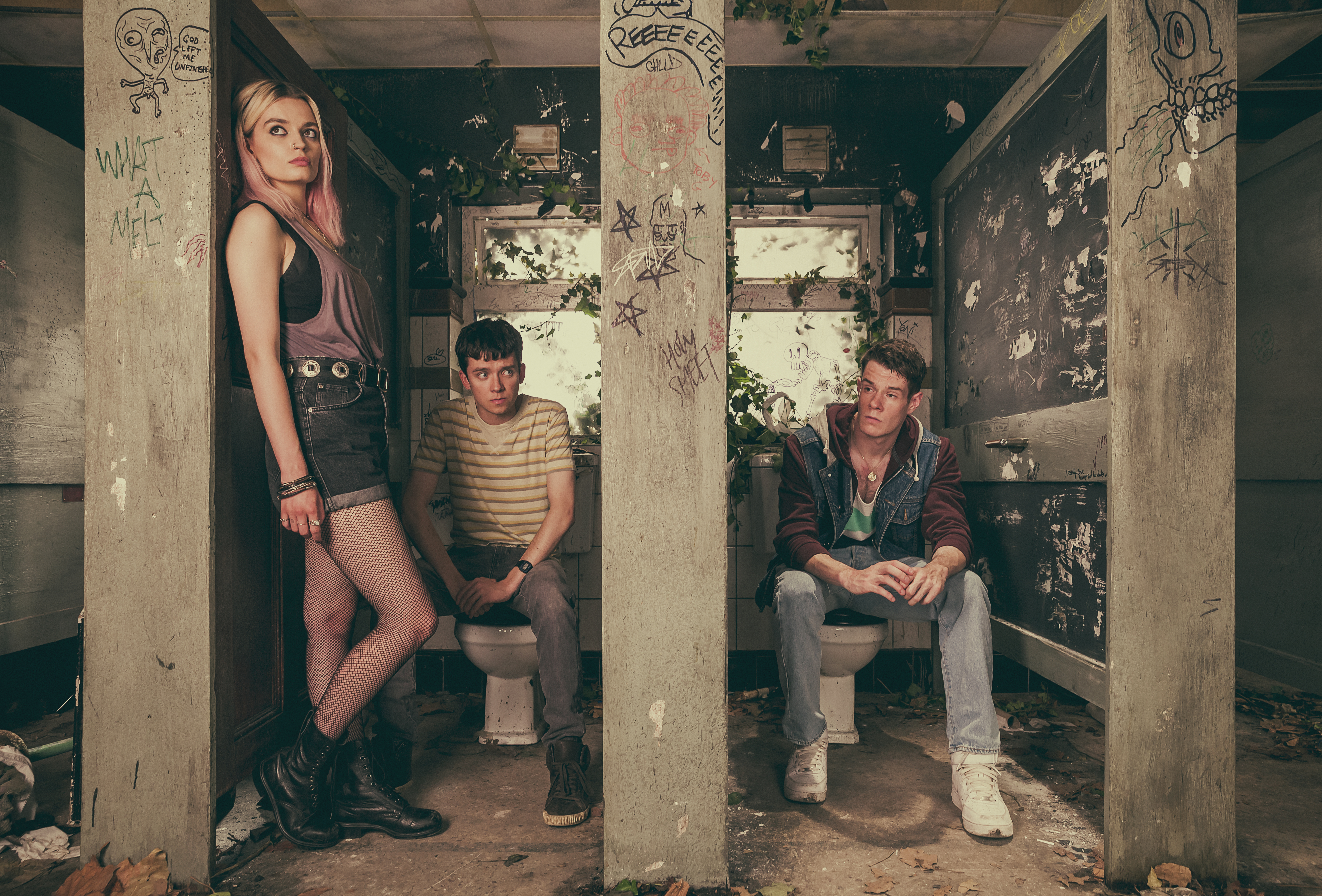
Sex Education is a surprisingly deep show, in terms of its ensemble.
Otis, the sex therapist’s son turned high school sex therapist, is undoubtedly the show’s lead. And his relationships with his mother, his best friend Eric, and his business partner/romantic interest Maeve are the most important relationships in the show. But as the show introduced other characters, it becomes more and more invested in their lives: while some “clients” appear and disappear in the episode where their problem emerges as an episodic point, others like Adam, Aimee, and Lily become part of the fabric of the show. It adds richness to a show that could have become tired amidst the tropes it deploys in order to stake its claim to ’80s teen movie nostalgia.
But when it comes to its finale, the writers’ interest in their supporting characters couple of hiccups for Sex Education, wherein story developments didn’t necessarily have the effect the writers desired.
When American Vandal debuted last fall, it was a surprise: the show launched with little fanfare, and read as a sketch concept more than a television series. But if there were any questions about whether a satire of true crime documentaries focused on phallic high school vandalism could sustain a season of television, American Vandal answered them with an affirmative yes. Not only did the series find plenty of humor in the spray-painted dicks and the lead suspect Dylan Maxwell, but it also wove a complex story about the students who were documenting the attempts to exonerate him, eventually landing on some really honestly quite profound observations about both the ethics of true crime investigations and the daily challenge of existing as a high school student in our contemporary moment. That it did so while committing to the verisimilitude of its diegetic social media posts may have been what burrowed it straight into my heart, but the way the series unraveled into a quite meaningful study of adolescence made it one of my favorite shows of last year, and earned it a Peabody Award this Spring.
The idea of a second season came with a new set of questions, however. Although some (wrongly) insist that the first season came to an ambiguous ending, the story of Dylan Maxwell and “Who Drew The Dicks?” ultimately did end, meaning that the show moving forward would need to approach itself as a seasonal anthology series, wherein each season focuses on a different crime. Given that the true crime documentary genre remains incredibly successful, and has various iterations and formats that can be used to fuel further satire, I can see why all parties—Netflix with a successful series with young demos, CBS looking to leverage that success to increase their license fees as the show’s production studio, the producers thinking about ideas and styles they wanted to explore—would be willing to move forward with a second season.
Photo: Scott Patrick Green / Netflix
American Vandal season two taps into the same ideas that made the first season so surprisingly profound, telling another story about the minefield of modern high school existence told through a juvenile (in this case scatological) criminal act, this time at a Catholic high school in Washington. But in its efforts to try to replicate the success of the first season, the producers decided to retain a key piece of continuity: the men behind the camera, Peter Maldonado and Sam Ecklund, who travel to Saint Bernardine High School to produce the second season of American Vandal as their senior project. Given how critical Peter’s choices were in the consequences of the production of the documentary in season one, and how much Peter and Sam’s relationship fueled the later drama in that season, I saw the choice to retain the two filmmakers as an effort to tap into the interconnectivity that made the first season resonate the way it did.
Which is why it was so disappointing when I reached the end of the second season and realized that Peter and Sam might as well have not even been involved.
To All The Boys I’ve Loved Before is neither the first nor the last teen romantic comedy launched by Netflix this year: it was preceded by The Kissing Booth, and it will be followed next weekend by Sierra Burgess Is A Loser, with all three films sharing an interest in reclaiming a genre that has been increasingly marginalized by major studios.
But whereas The Kissing Booth is an ideological garbage fire that was rightfully criticized for its wonky gender politics (and, on a personal note, a distinct lack of quality control beyond that), To All The Boys I’ve Loved Before has elevated Netflix’s “Teen Rom-Com Renaissance” while still replicating the “viral” success of The Kissing Booth that signaled the demand for the genre. By the metric of views of “Cast Content” on YouTube—generated by various magazines and websites that pivoted to video in recent years, along with Netflix itself—the story of Lara Jean Song Covey’s letters and her fake relationship with Peter Kavinsky is generating just as much social chatter as its predecessor, but with closer attention to cinematic style and a far less problematic take on teenage romance. The result has been an almost overwhelming response to the film across social media, as Peter Kavinsky (and by extension actor Noah Centineo) became the internet’s boyfriend, and Netflix has the watercooler media that the film’s target demos will carry with them into the school year.
But for any of this to happen, the film itself needs to create moments that fans want to GIF, and a story that leaves them with an emotional reaction that convinces them to take to social media to change their profile pictures, post their edits, and reorient their online existence around this story and the people involved. And that story owes a lot to the Jenny Han book on which the movie is based, and I do think that the film would be generating a significant response even if it would have just taken the story as it was told and brought these characters to life in the capable and charming hands of Centineo and Lana Condor, who doesn’t get enough credit for her work as Lara Jean. But as I discovered when I dove down the To All The Boys I’ve Loved Before rabbit hole over the past two weeks, writer Sofia Alvarez and the film’s producers made a series of conscious choices when adapting the book that engineered the story to maximize this type of response.
They’re also choices that I’d argue make it almost impossible to adapt the rest of the series as it was written.
I’m Canadian, and thus compelled to use this promotional still of Henry playing hockey, which I remain deeply entertained they released before the finale. Bless you, FX.
That’s bizarre to me, but not unexpected: the show debuted in the midst of graduate school, when reviews became more scarce and the blog in general became less of a priority. It was also a show that I, for various reasons, found myself always falling behind on within a given season, such that I often wasn’t current enough to write something even if I had found time or the inclination to say something. And while I’ve been more vocal about my appreciation for the show on my Twitter feed, it still feels weird to have never really tried to grapple with my relationship with the show in this setting.
I’m not going to try to encapsulate the entire series in this review, or else I’d be up all night. But I did want to briefly capture why “START” is such a compelling entry into the pantheon of serialized drama finales, despite in some ways departing from tradition. While far from the cut-to-black ending of The Sopranos, The Americans still works against many of the instincts of contemporary drama storytelling, and in doing so managed to reinforce and strengthen my connection to these characters that’s existed even if I’ve never quite put it into words.


 This week, I’m thrilled to say that Communication, Culture and Critique has published my article





 Cultural Learnings